As I sit here, half a world away, in Mendon, Missouri, scrolling through the latest headlines at 2:43 AM, the situation in Iran commands attention. Protests that erupted late last month over economic hardships have morphed into a nationwide cry against the regime, met with a brutal crackdown that’s left thousands dead. Estimates vary wildly: UN Special Rapporteur Mai Sato suggests the civilian toll could exceed 20,000 based on reports from doctors inside the country, while activist groups like HRANA peg verified deaths at around 5,000 or more, and the regime’s own figures claim 3,117 (including many attributed to “terrorist attacks” or security forces). The streets have quieted for now under an iron fist—internet blackouts surpassing two weeks, mass arrests exceeding 26,000 by some counts, and leaked photos of battered victims painting a grim picture. Yet, amid the repression, voices like Reza Pahlavi, the exiled son of Iran’s last Shah, are gaining traction. From abroad, he’s issued six specific demands for international and diaspora pressure: targeted measures to weaken the regime, release of political prisoners, support for activists, preparation for a democratic transition, recognition of a legitimate transitional government, and continued global rallies to sustain hope. Protesters have chanted his name and waved pre-1979 flags, signaling a deep yearning for change that reaches back to a pre-revolutionary era.
Adding layers to this tension is the U.S. response. President Trump, fresh from ratifying the Board of Peace in Davos, has kept Iran firmly in his sights. He’s claimed his warnings halted hundreds of executions and influenced the regime’s behavior, but the military buildup is unmistakable. The USS Abraham Lincoln carrier strike group—diverted from the South China Sea—has transited the Malacca Strait, crossed into the Indian Ocean (recently spotted in the Andaman Sea), and is steaming toward the Arabian Sea or Persian Gulf, with arrival expected imminently, possibly by late January 23–25. Accompanied by destroyers, F-35 jets, THAAD missile defenses, aerial refueling tankers, and possibly additional carriers like the USS George H.W. Bush, Trump described it as a “big flotilla,” “armada,” and “massive fleet” heading Iran’s way—just in case.
“I’d rather not see anything happen,” Trump said aboard Air Force One, “but we’re watching them very closely.”
Israel, too, is on high alert, with Transportation Minister Miri Regev confirming that airlines (El Al, Arkia, Israir, and others) have contingency plans to quickly evacuate their ~85-plane civilian fleets to Cyprus, Greece, or farther afield if Iranian missiles fly—drawing from protocols used in past escalations. This preparedness underscores the fragility: a single misstep could ignite broader conflict.
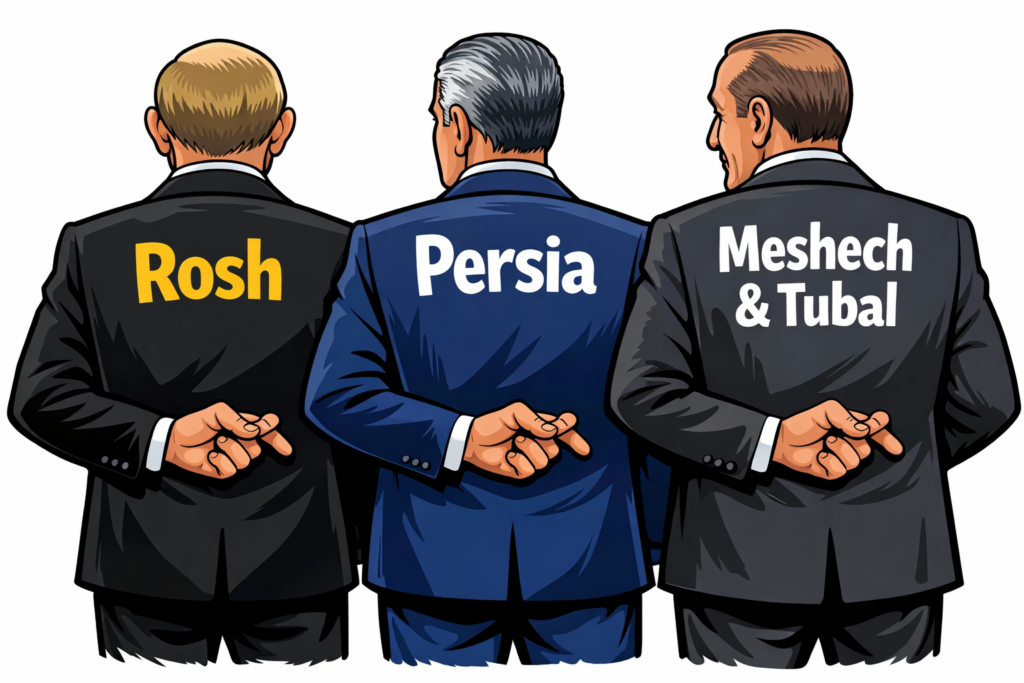
It’s here, in this cauldron of unrest and diplomacy, that an ancient biblical text comes to mind—not as a roadmap or definitive prediction, but as a point of intriguing reflection. Ezekiel 38 speaks of a future coalition invading a secure Israel, led by “Gog of the land of Magog” from the “far north,” joined by Persia (ancient Persia, modern-day Iran), among others like Meshech, Tubal, Cush, and Put. Interpreters often map this to modern players: Russia as the northern power, Rosh, Iran as Persia, Turkey (and sometimes Central Asian states) rounding out the alliance. The key setup? Israel dwelling in safety, without walls or bars—a period of relative peace before the storm. This isn’t about pinpointing dates or declaring fulfillments; it’s about pondering parallels that make you wonder if larger patterns might be at play in unexpected ways.
Wouldn’t it be interesting if today’s headlines were subtly aligning with that? Consider the Board of Peace, Trump’s new initiative for Gaza reconstruction and broader stability, which has drawn in around 25–35 countries so far, including Turkey (a key Ezekiel player with representatives signing on at Davos) and left the door open for Russia (invited, but still “studying” it amid talks of a $1 billion contribution, possibly from frozen assets for humanitarian aid). The Board, chaired by Trump himself, emphasizes accountability and peace through strength, with permanent seats tied to hefty financial commitments. If Iran’s regime crumbles—far from guaranteed, given the crackdown’s success in quelling visible protests for now—and a figure like Pahlavi steps in, pledging to recognize Israel, end proxy support for groups like Hamas and Hezbollah, dismantle the nuclear program, and join expanded “Cyrus Accords” (uniting Iran, Israel, and Arab states), it could neutralize one of Israel’s fiercest threats. A reformed Iran (perhaps even reverting symbolically to “Persia,” evoking Cyrus the Great’s benevolence toward the Jews in ancient times) might integrate into this peace framework, lulling the region into that prophesied security.
Expanding on this, imagine the ripple effects: With Iran pivoting away from its anti-Israel stance, proxies like Hezbollah could lose funding and fracture, while Hamas—already diminished post-Gaza conflict—fades further. The Board of Peace, with its mix of Middle Eastern states (Saudi Arabia, UAE, Jordan, Bahrain, Qatar) and others like Hungary, Argentina, and Indonesia, could symbolize a new era of cooperation. Russia, if it commits (amid ongoing diplomacy tied to Ukraine and Gaza aid), adds the “far north” dimension. But here’s the twist: What if this well-intentioned “board” of allies—meant for good—ironically gathers the very coalition Ezekiel describes? Russia joins for pragmatic reasons (humanitarian optics or leverage), Turkey leverages its position for regional influence, and a post-revolutionary Iran gets pulled back into old orbits through economic pressures or shifting alliances. The invasion comes not from overt enemies, but from supposed partners, catching everyone off guard. No wonder the text has onlookers questioning but not intervening—diplomatic ties could paralyze a response, leaving God to defend Israel supernaturally.
This isn’t a prediction; it’s speculation born of observation. God doesn’t generally do things the way we think He will. We’ve seen it before: Joseph sold into slavery, only to save his family; a Messiah born in a manger, not a palace. For years, prophecy watchers assumed a Russia-Iran-Turkey bloc would form through shared hostility or Islamism. But a peace-oriented alliance? That’s the kind of unexpected path that makes you pause. As the proverb goes, “The road to Hell is paved with good intentions”—noble efforts for stability could blind us to deeper undercurrents, whether geopolitical rivalries or spiritual forces.
To be clear, many scholars debate Ezekiel’s timing and symbolism—some see it as historical, others as mid-Tribulation or post-millennial. And Iran’s protests might fizzle without regime change; the military buildup could deter without detonating. Yet, with the 40-day mourning periods approaching and global eyes fixed, it’s a moment that invites reflection. In the end, we watch and wait, discerning without declaring. Iran’s fate hangs in the balance: Will protests reignite around economic triggers or mourning cycles? Will Trump’s armada deter or escalate? If change comes, and Iran pivots toward peace, it might just create the calm before a greater storm. Or perhaps not—prophecy unfolds on God’s timeline, not ours. For now, it’s a reminder to stay vigilant, pray for those suffering, and marvel at how current events echo ancient words in ways we never anticipated.